


Every Nichirin Sword Colour Explained: The Complete Demon Slayer Blade Guide
Nichirin blades are the defining visual shorthand of Demon Slayer. Every time a new Slayer grips their sword for the first time, it changes colour. That colour tells you who the person is, which breathing style they use, and sometimes something stranger. Tanjiro's black blade confused the in-universe characters and the fandom in equal measure. Rengoku's vivid flame-orange is instantly readable. Zenitsu's yellow makes immediate sense the first time he uses Thunderclap and Flash.
This post breaks down every confirmed Nichirin colour in the series: the primary user, what the colour signals, and the lore behind each one. The post pairs with the Hashira ranking, which covers the characters in depth, and the Upper Moons post for the villain side of every fight these blades appear in.
TL;DR: what each colour means
- Black: Sun Breathing lineage, extreme rarity, historically associated with Slayers who die young
- Red (Crimson): Flame Breathing and the Blood Demon Art countermeasure (red blades suppress demon regeneration on contact)
- White: Mist Breathing, softness and clarity in the user
- Pink: Flower Breathing, tied to the Kocho sisters' legacy
- Green: Wind Breathing, earth and force
- Blue: Water Breathing, the most common high-ranking style
- Indigo/Purple: Insect Breathing, mirrors the poison-thrust fighting style
- Grey: Stone Breathing, durability and mass over finesse
- Yellow: Thunder Breathing, the lightning motif made literal
- Crimson/Orange: the base tone of Flame Breathing blades before the temporary red state activates
Black: Tanjiro Kamado
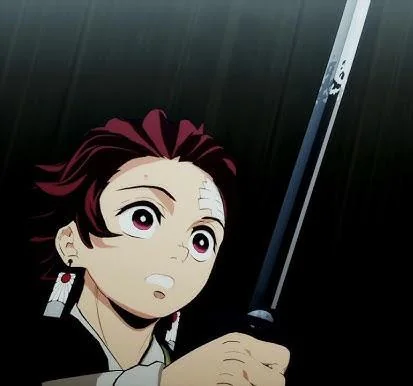
Black
Primary user: Tanjiro Kamado. The rarest blade colour in the series and the one with the most negative folklore attached to it. When Tanjiro's blade turned black after he first gripped it, the swordsmith Hotaru Haganezuka reacted with visible distress. Within the Demon Slayer Corps, black blades carry a specific reputation: historically, Slayers who manifest black have never risen to Hashira rank. The precise reason was unknown to the characters for most of the series. The answer the final arc provides connects black directly to Sun Breathing. Yoriichi Tsugikuni, who created Sun Breathing 500 years before the story, wielded a black blade. His style, the origin of all other Breathing Styles, was lost, covered over, and eventually survived only as the Kamado family's Hinokami Kagura ritual. The black colour is the steel recognising the Sun Breathing lineage. The historical Slayers who manifested black presumably did not have the physical or spiritual aptitude to use Sun Breathing properly, which made the colour a marker of untapped potential that never activated rather than weakness. Tanjiro is the exception: he gradually unlocks the full Hinokami Kagura form and eventually uses the Thirteenth Form against Muzan.
Red (Crimson): Rengoku and the Blood Demon Art countermeasure
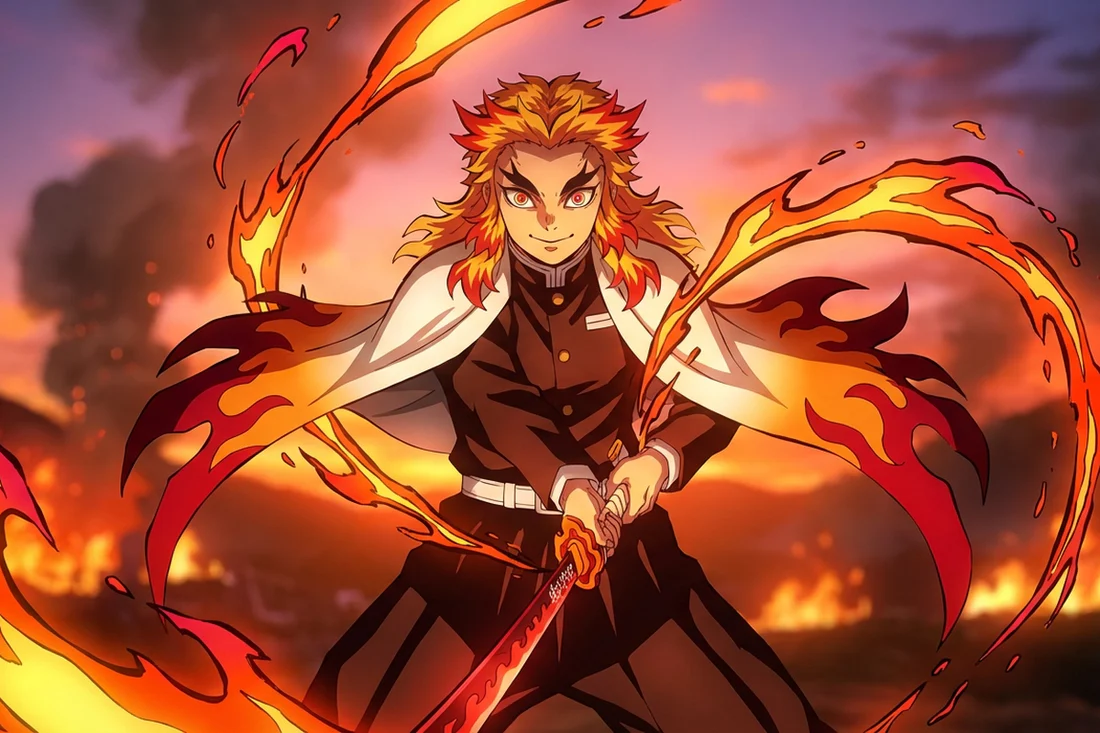
Red (Crimson)
Primary user: Kyojuro Rengoku. Flame Breathing's natural colour is a deep crimson-orange, one of the most immediately readable blade colours in the series. But the series distinguishes between the base crimson colour and the temporary Crimson Red Nichirin state, which is a separate mechanic. The Crimson Red Nichirin state is not automatic: a blade turns vivid red only when it is heated through extreme body temperature, Slayer Marks, or in Tanjiro's case, by having his hands squeezed by Nezuko's Blood Demon Art fire during the fight with Hantengu. A blade in the Crimson Red state has a specific combat property that no other Nichirin colour possesses: it suppresses demon regeneration on contact. Demons who are cut by a Crimson Red blade cannot regenerate that wound at normal speed. This is the in-universe reason why the technique matters strategically against Upper Moons, whose regeneration is otherwise fast enough to make even decapitation attempts recoverable if the blade is not moving fast enough. Rengoku's base blade is the orange-crimson of Flame Breathing; the Crimson Red upgrade is a second, temporary state layered on top of it.
White: Muichiro Tokito
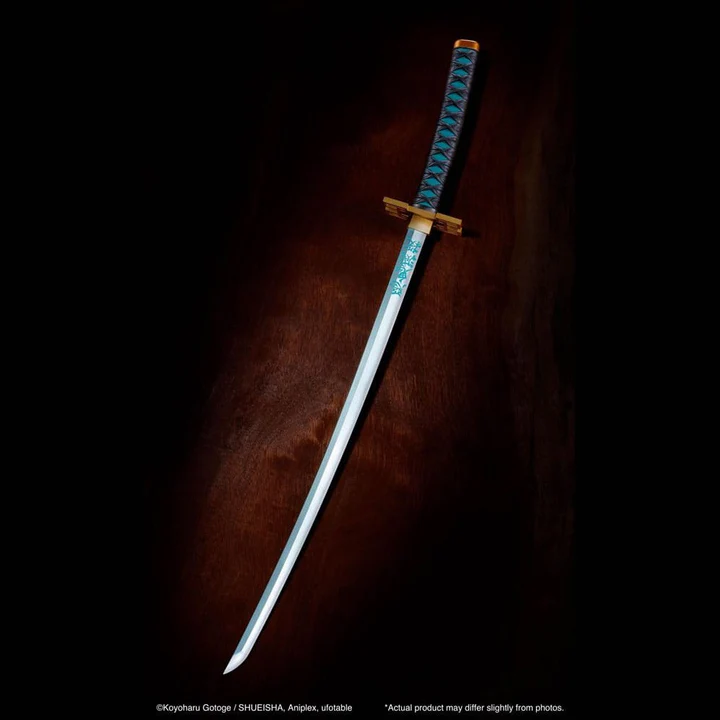
White
Primary user: Muichiro Tokito, Mist Hashira. The white blade is one of the more visually striking in the series precisely because white reads as the absence of colour rather than a colour choice. For Mist Breathing, that absence is appropriate: the style is built around deception, irregular rhythm, and attacks that change speed mid-motion to become unreadable. A white blade in motion is harder to track than a strongly coloured one, which is functionally consistent with the style's design philosophy. Muichiro's personality during most of the series (emotionless, detached, with no memory of his past) mirrors the blank quality of the blade. After he recovers his memories and connection to his brother Yuichiro, the white takes on a different reading: purity of purpose, with nothing obscuring his commitment to his goal. He activates his Demon Slayer Mark during the fight against Upper Moon Five (Gyokko), and his blade does not change colour when the Mark activates. See the Upper Moons post for Gyokko's full fight breakdown.
Pink: Kanao Tsuyuri
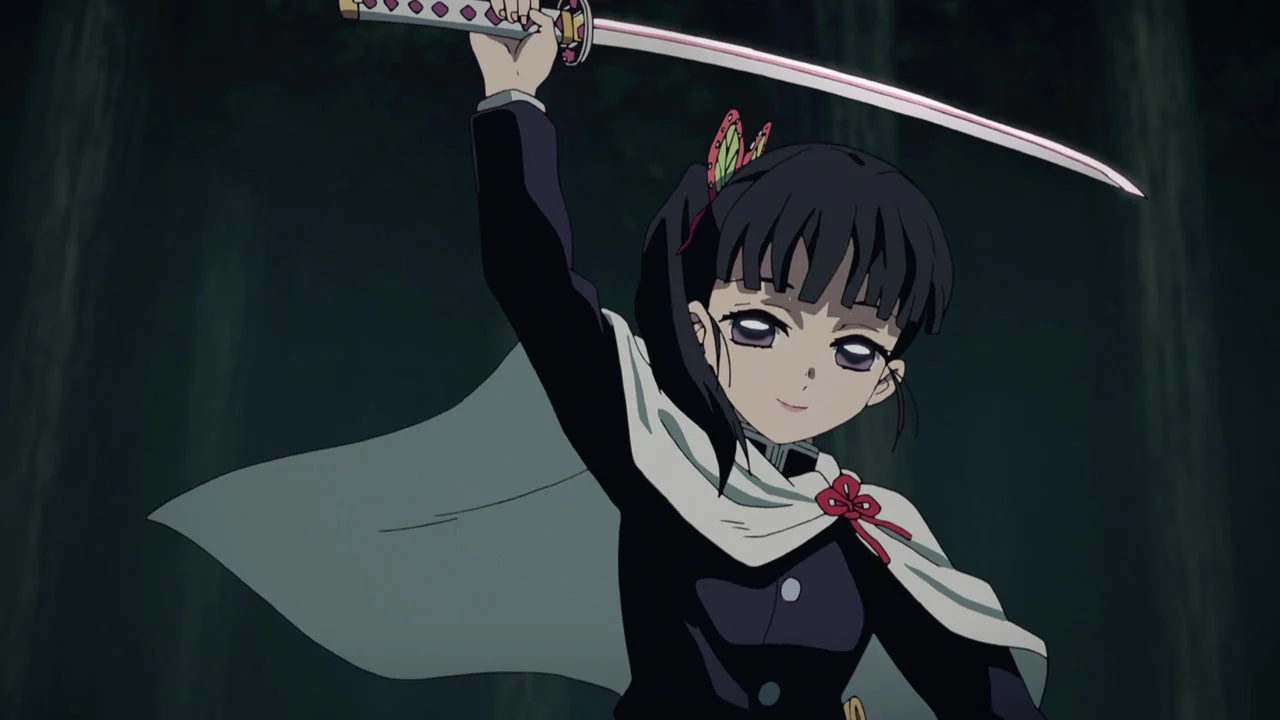
Pink
Primary user: Kanao Tsuyuri. Kanao uses Flower Breathing, the style originally developed by her adoptive older sister Kanae Kocho (the deceased Flower Hashira) and derived from Water Breathing. The pink blade directly mirrors Kanae's legacy: it is a visual line of inheritance from sister to adopted sister. Kanao's fighting style is built around extreme precision and reaction speed, cultivated as a response to her upbringing, which left her unable to make decisions independently. She learned to fight by amplifying her sight and reflexes to the point that her eyes could follow and respond to things faster than her conscious mind. Her final technique against Upper Moon Two (Doma), Flower Breathing: Scarlet Spider Lily Eyes, achieves this at such extreme intensity that it risks destroying her optic nerves permanently. The pink blade is the aesthetic thread connecting her to Kanae, whose death at Doma's hands is what ultimately motivates Kanao's commitment to the Demon Slayer Corps.
Green: Sanemi Shinazugawa
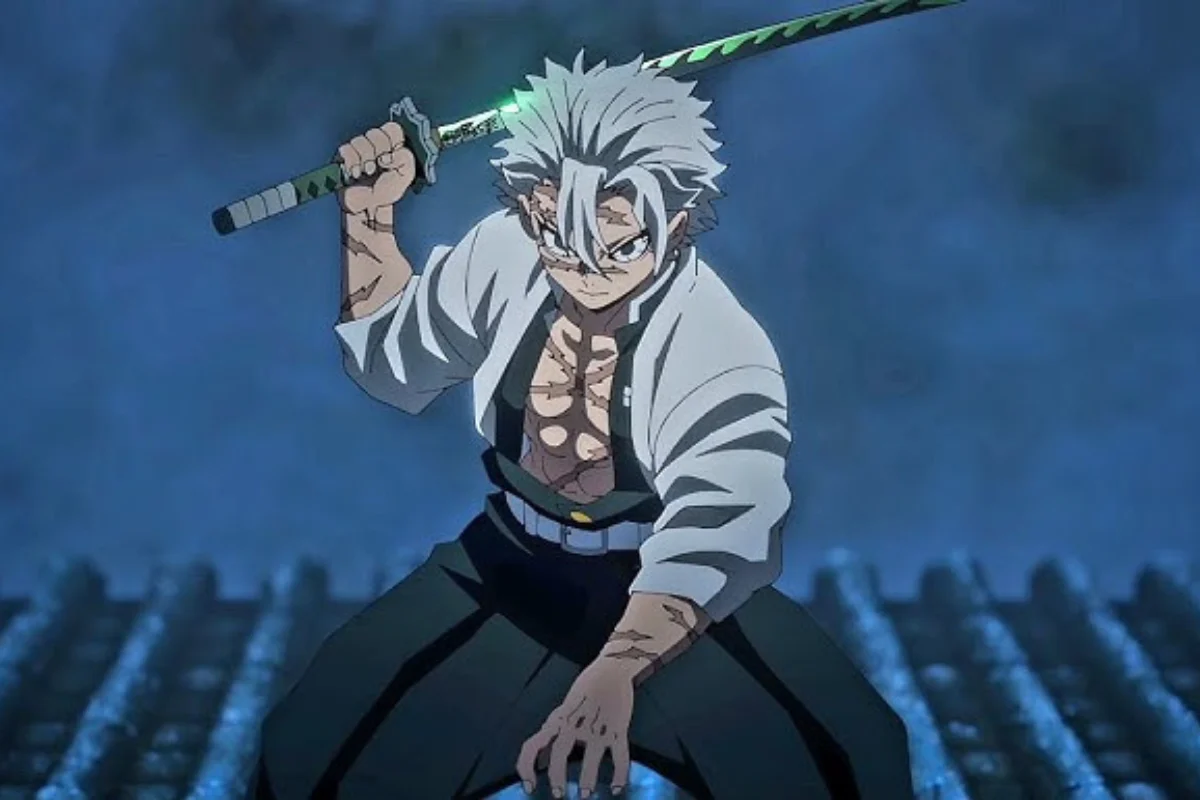
Green
Primary user: Sanemi Shinazugawa, Wind Hashira. Wind Breathing techniques are built around wide, sweeping cuts and rotational force. The green blade's earthy tone reads as grounded power rather than elemental flash, which fits Sanemi's fighting style: aggressive, forward-moving, entirely without the elegance of Water or the precision of Mist. His blade is the heaviest-feeling of the major Hashira blades in terms of visual language. Sanemi is also one of the physically toughest Hashira in the current generation, compounding this further with his Marechi blood (rare blood type that intoxicates demons who smell it, disrupting their focus in combat). His performance in the Kokushibo fight, including activating his Demon Slayer Mark and continuing to fight after severe injury, is the primary demonstration of what Wind Breathing looks like at full output. Note: Giyu Tomioka's Water Breathing blade sometimes appears as a blue-green depending on lighting in the anime adaptation, but the canonical Water Breathing colour is a deeper, cleaner blue.
Blue: Giyu Tomioka
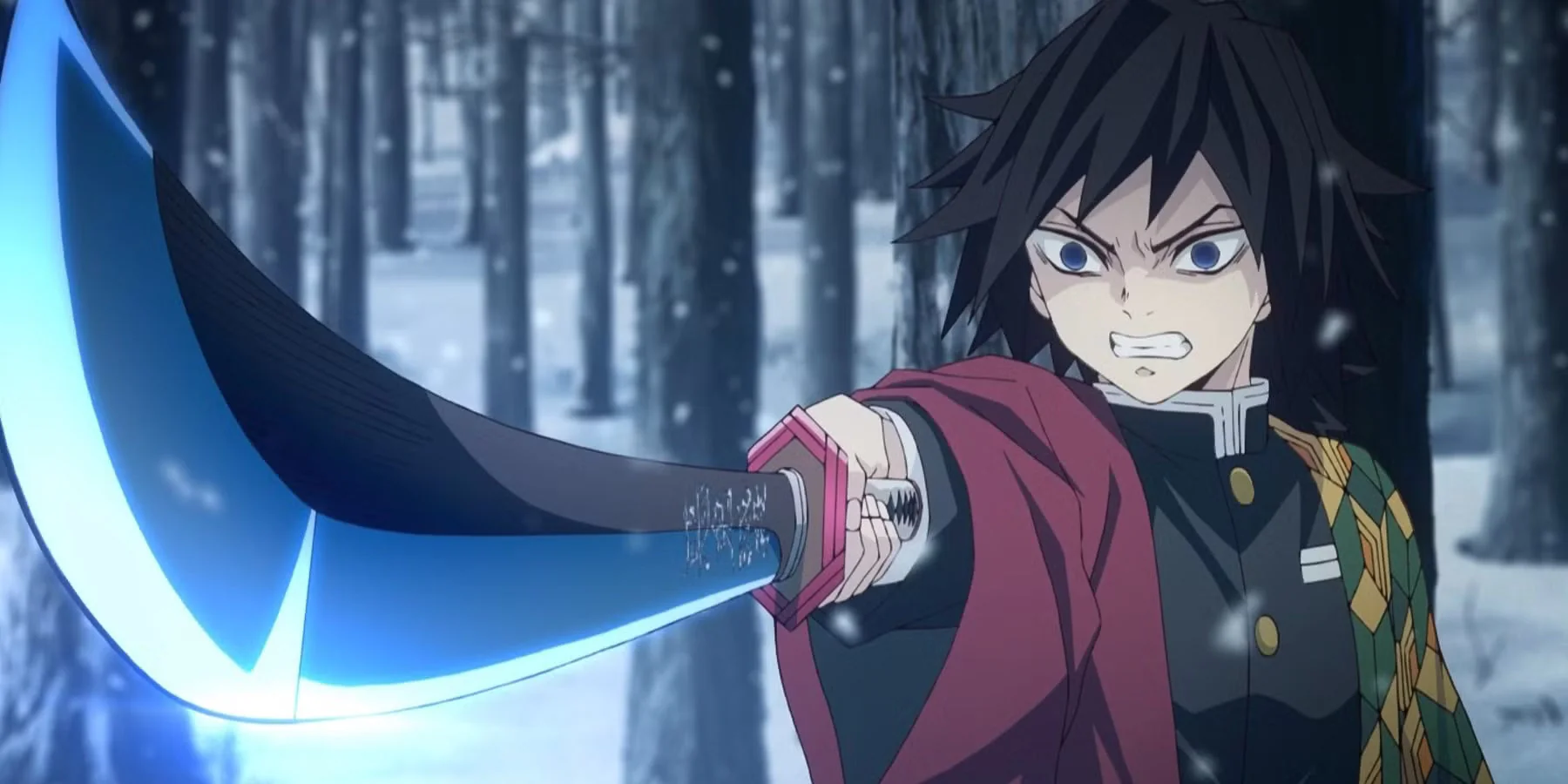
Blue
Primary user: Giyu Tomioka, Water Hashira. Water Breathing is the most widely taught style in the Corps: Sakonji Urokodaki's training produces more graduates than any other master in the series, and Tanjiro himself originally trained in it before his Sun Breathing lineage became apparent. The blue blade is the colour most commonly associated with the Demon Slayer Corps in the public imagination, partly because Water Breathing is the first style shown in depth and partly because Giyu appears in both the first episode and the Mugen Train sequence. His Eleventh Form: Dead Calm is an unofficial technique he invented himself, not part of the canonical ten Water Breathing forms, and it is what kills Rui on Natagumo Mountain after Tanjiro's Hinokami Kagura severed his threads. The blue colour reads as calm, controlled, and deep. Giyu's personality (distant, reticent, operating with minimal external expression) fits this reading without the series making the connection explicit. He activates his Demon Slayer Mark during the fight with Upper Moon Three (Akaza) in the war arc.
Indigo/Purple: Shinobu Kocho
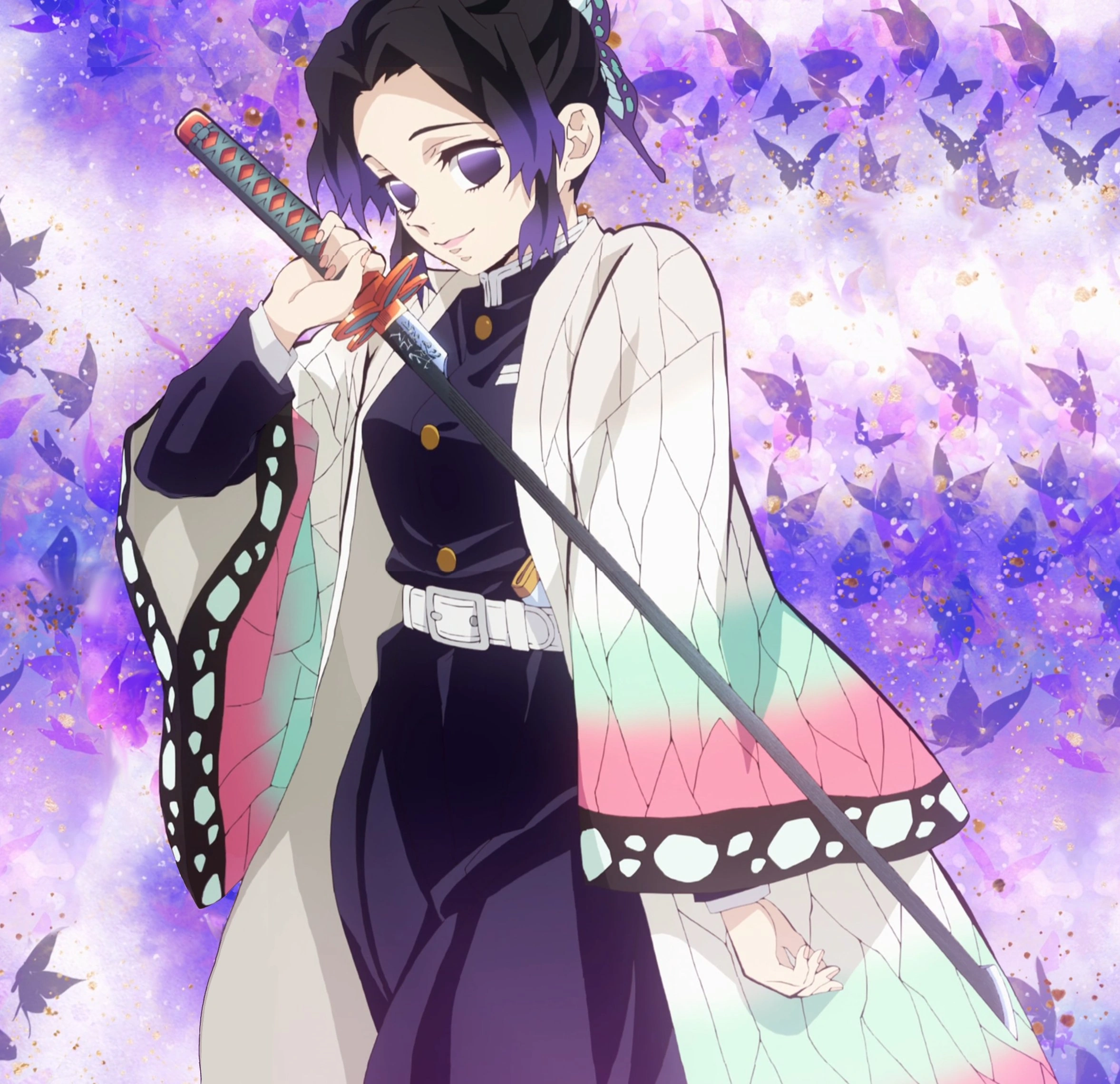
Indigo/Purple
Primary user: Shinobu Kocho, Insect Hashira. The indigo-purple blade is the most structurally unusual in the series because Shinobu's blade has a physically different tip from every other Nichirin sword: it is needle-fine, designed to deliver poison rather than to cut. Shinobu cannot decapitate a demon. Her physical strength is insufficient for a clean decapitation strike against any demon with meaningful regenerative ability. Insect Breathing was developed specifically around this constraint: the forms are built for speed, precision, and repeat puncture strikes, each delivering a wisteria-derived poison dose. The purple colour mirrors the wisteria flower, which is the source of all demon-killing poisons used by the Corps (wisteria is the plant that suppresses Muzan's cells). In the final fight against Upper Moon Two (Doma), Shinobu had spent months absorbing wisteria poison into her own body tissue, so that when Doma absorbed her entire body, the dose was large enough to begin killing him from inside. The purple blade, visually tied to the plant that powers the strategy, makes the connection legible. Details on Doma's fight are in the Upper Moons post.
Grey: Gyomei Himejima
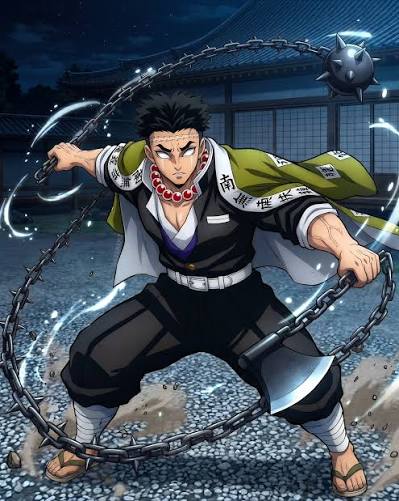
Grey
Primary user: Gyomei Himejima, Stone Hashira. The grey designation applies to Gyomei's weapon, but with an important caveat: Gyomei does not use a sword. His Nichirin weapon is a spiked flail and axe on a chain, making him the only Hashira who fights with a non-katana Nichirin configuration. The same forging process applies (Scarlet Crimson Iron Sand, absorbing sunlight at high altitude) and the steel changes colour the same way. Grey for Stone Breathing fits the elemental logic: stone is the colour of granite, mass, and permanence. Stone Breathing techniques prioritise power and impact force over speed or trajectory. Gyomei is described within the series as the strongest Hashira of his generation, with Tanjiro and other characters explicitly framing him as above the rest of the current roster. His Demon Slayer Mark activates during the Kokushibo fight, and the sequence is the most significant demonstration of Stone Breathing at full output in the series.
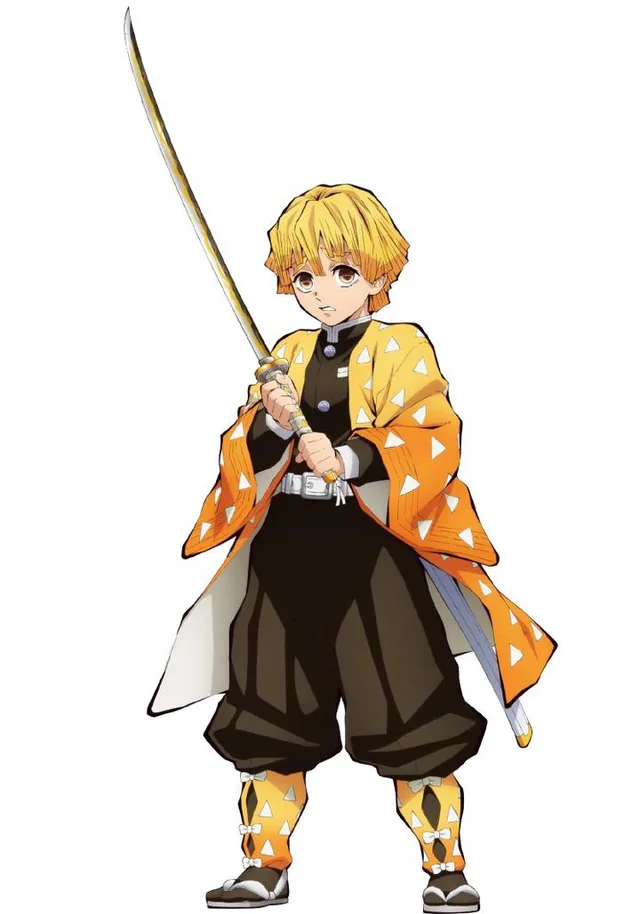
Yellow: Zenitsu Agatsuma
Yellow
Primary user: Zenitsu Agatsuma. Thunder Breathing's yellow blade is one of the most recognisable in the series, partly because Zenitsu is one of the most-searched characters and partly because the yellow blade with a lightning pattern on the hilt is exactly what Thunder Breathing should look like. The colour is straightforward elemental design: yellow is the canonical colour of lightning across every visual medium, and Thunder Breathing's core technique (Thunderclap and Flash, a draw-and-slash at maximum speed) is built entirely on that motif. Zenitsu is unusual because he can only access Thunder Breathing while unconscious or in a dissociative state triggered by extreme fear. In that state his speed exceeds what most conscious technique users demonstrate, and he subsequently developed a Seventh Form (Flaming Thunder God) independently, combining the thunder motif with an aerial approach no prior form attempted. The yellow blade with its lightning-pattern hilt is the signature collector item in the Thunder Breathing range.
The Yoriichi problem
Yoriichi Tsugikuni and the black blade origin
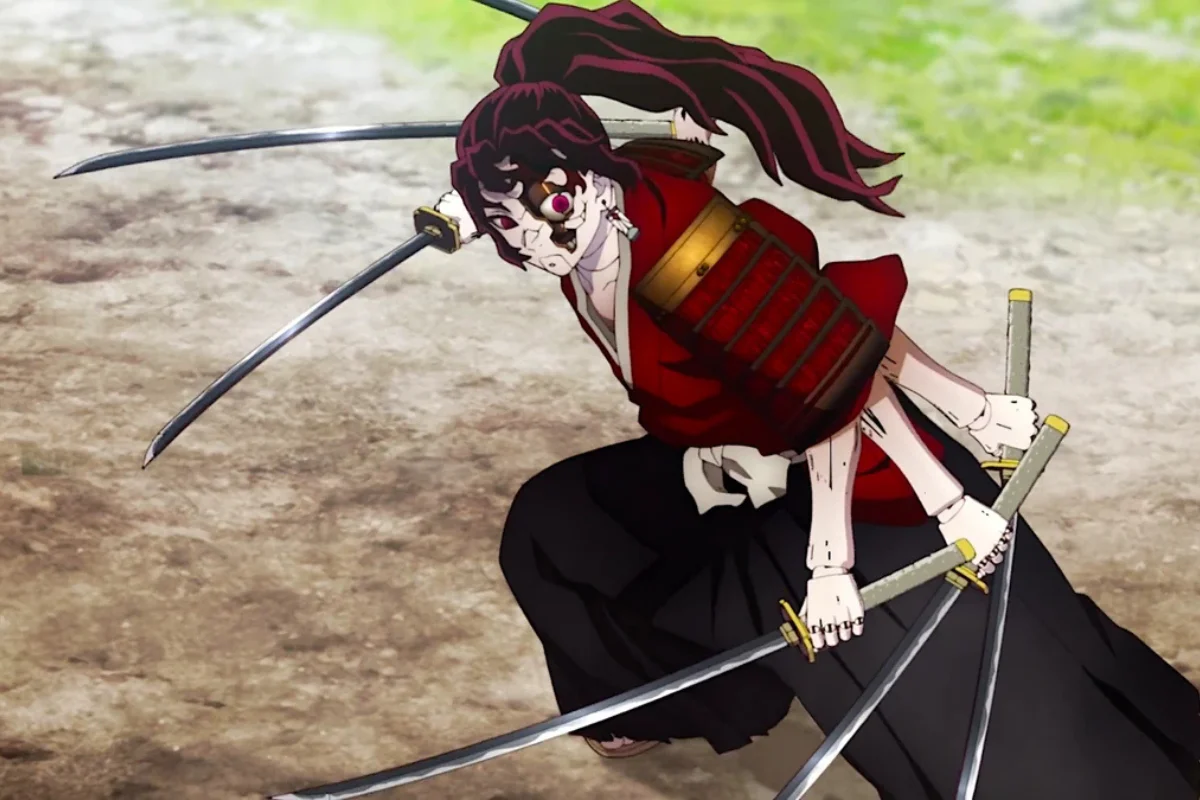
The reason black blades carry their specific folklore ties directly to Yoriichi Tsugikuni. Yoriichi was born with the Demon Slayer Mark active from birth: the only recorded instance in history. He developed Sun Breathing not as a learnable technique but as an expression of his own physical nature, and he wielded a black Nichirin blade throughout his life. He is the only demon slayer who ever wounded Muzan Kibutsuji severely enough to force cellular subdivision as a survival response. After Yoriichi's death, the connection between black blades and Sun Breathing was lost. Subsequent Slayers who manifested black had the colouring but not the style: they presumably carried some latent aptitude for Sun Breathing without access to the technique, which the Corps could not explain and which never translated into the combat performance needed for Hashira rank. The "black blade wielders die young" folklore is the accumulated record of those Slayers. Tanjiro's black blade is not a curse. It is the steel recognising what he inherited from his father's Hinokami Kagura lineage before Tanjiro himself understood what it was. The stone statue of Yoriichi in the Kamado family's shrine, confirmed to hold a black blade, is the physical evidence that connects the dots retroactively.
Why does the colour change?
Nichirin blades are forged from Scarlet Crimson Iron Sand and Scarlet Crimson Ore, smelted from iron deposits found only at high altitudes where the ore has been exposed to direct sunlight continuously for centuries. The forging process is designed to load the resulting steel with absorbed solar energy, which is what gives Nichirin blades their demon-killing property: they carry sunlight in physical form, which is why contact with a Nichirin blade can slow or prevent demon regeneration (even without the Crimson Red upgrade) and why decapitation by Nichirin is one of the only reliable demon-kill conditions in the series.
The colour change on first grip is the steel responding to the wielder's spiritual affinity and breathing style. When a Slayer picks up a Nichirin blade for the first time and channels their breathing, the blade's stored solar energy aligns with the specific energy signature of that person. Flame Breathing produces the crimson-orange alignment. Water Breathing produces blue. Sun Breathing, the origin of the whole system and the style most directly tied to the sunlight energy the steel was forged to carry, produces black.
The metallurgical explanation and the spiritual explanation are two framings of the same mechanic. The steel has memory. It remembers sunlight, and it responds to whoever can channel that memory most directly.
The collector angle
Nichirin replica swords are the highest-volume Demon Slayer collector category in the UK market, and the colour system is exactly why: every fan can identify "their" blade based on their favourite character or breathing style.
The most-requested replicas are Tanjiro's black blade (the most distinctive and the protagonist's), Rengoku's crimson-orange (the Mugen Train effect on mainstream audiences has not faded), Zenitsu's yellow with lightning-pattern hilt, and Shinobu's needle-tipped purple, which is the only replica that is immediately visually distinct from a standard katana shape.
The quality variance on Nichirin replicas is significant. The key markers: blade colour saturation (cheap replicas fade from the tip rather than holding consistent colour throughout the blade), hilt pattern accuracy (the lightning pattern on Zenitsu's and the water-wave etching on Giyu's are the most commonly compromised on budget versions), and the tsuba (guard) shape, which differs per character.
AnimeVault's Figures and Merch forum has ongoing discussions on which Nichirin replica brands are worth buying for UK collectors. Check the listings for current stock. The Lower Moons post has additional context on Rui's thread-based combat for anyone cross-referencing Nichirin limits against demon-tier opponents.
More from the blog
Get new anime collector posts in your inbox.
Reviews, guides, and hobby news — delivered directly.
By subscribing, you agree to our Privacy Policy.